
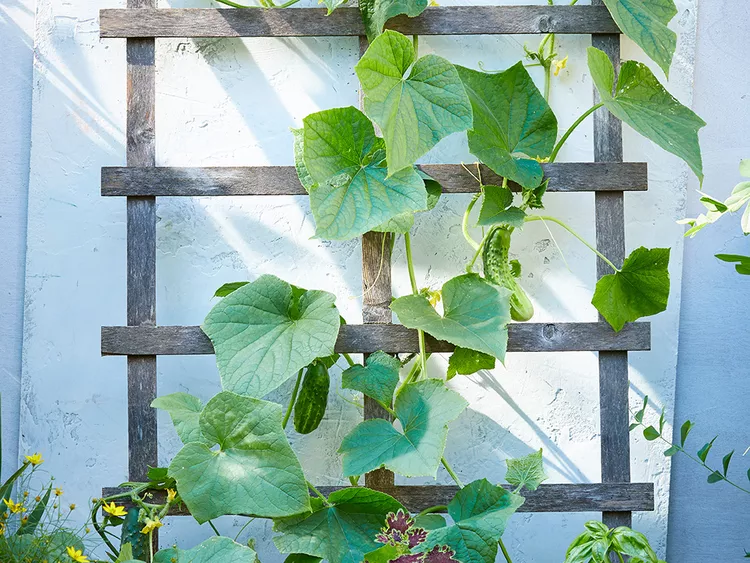
You don’t need a trellis to grow cucumbers, but if you want to maximize your gardening space and keep your cucumbers off the soil, grow your cucumber plant on a trellis. Whether you like picklers, slicers, or burpless types of cucumbers, vining varieties are available that will quickly climb a trellis and make harvesting easier for you. This guide contains expert tips on how to grow cucumbers on a trellis successfully.
Dr. Michael Mazourek is a vegetable breeder and associate professor at Cornell University’s School of Integrative Plant Science, Plant Breeding & Genetics Section, Horticulture Section.
Do Cucumbers Need a Trellis?
Not all cucumbers need a trellis. The type of cucumber you choose to plant determines whether a cucumber trellis is needed. Vining cucumbers are natural climbers, so trellising them helps you use vertical garden space more effectively.
“Some bush types won’t trellis well," says Dr. Michael Mazourek, associate professor of plant science and plant breeding at Cornell University. “Their vines never make it more than waist high. Other varieties, like ‘Persian’/‘Beit Alpha’ cucumbers, have thin skin and are less prone to blemishes on a trellis. Long types of cucumbers grow straight when grown on a trellis, but they grow curled up if grown on the ground.”
Reasons to Grow Cucumbers Vertically
When growing a vining variety of cucumber, growing it vertically on a trellis rather than letting it ramble along the ground offers a number of benefits:
- Maximize space in your garden. Vining cucumbers can be planted closer together when they’re trained to grow upward.
- Keep cucumber plants healthier. Vines growing upward will have more airflow around the foliage than they would on the ground. This discourages leaf diseases like powdery mildew from taking hold.
- Easier harvesting. Spotting cucumbers on a trellis is easier than finding them on the ground. Mazourek points out that missing some fruits hiding under the foliage on the ground could reduce your harvest in more ways than one. “As the cukes stay on the vine too long and get seedy, the plant sets fewer new cucumbers,” he says.
Tips for Growing Cucumbers on a Trellis
Use these tips to get the most out of trellising your cucumbers.
1. Choose vining cucumber varieties.
Even though there are plenty of good bush varieties of cucumbers, the best cucumber types for trellising are vining varieties. Your favorite slicing (the thick-skinned ones used for fresh eating), pickling (the short ones with thin skins that are used for fresh eating and pickling), and burpless varieties (the ones that have lower levels of cucurbitacin that makes cucumbers bitter and hard to digest) all are available as vining types.
The varieties you select can also be strategically planted to avoid certain pests and diseases. “Early in the season, I plant varieties with non-bitter foliage to protect them from cucumber beetles. ‘Silver Slicer’ and old-fashioned pickling cucumbers like the ‘Boston Pickling’ cucumber taste great, don’t need to be peeled, and the slices are the same size as my sandwich bread,” says Mazourek. "Later in the season, downy mildew wipes out cucumbers unless you are growing one of the rare resistant ones like my DMR401. In dry climates, fend off spider mites with bitter foliate types like ‘Salt and Pepper’."
2. Buy or make a DIY cucumber trellis.
When it comes to supporting your cucumber plant, there are beautiful trellis options to buy and simple plans to make a DIY trellis. Either way, the height of a trellis should be as tall as you can reach.
“I like to make an arch with three strong posts and hang cotton butcher’s twine down to the ground for the cukes to climb,” says Mazourek. “You can compost the twine at the end of the season with the plant. Just make sure to anchor the twine so it doesn’t blow around and get tangled before the cukes start growing. You can also use a piece of wire fence or wooden lattice. Just make sure to plan ahead for when the plants are big. You want your trellis to hold the weight of your crop and remain upright during high winds.”
Mazourek says you should adjust the trellis height based on your own height, shading on the rest of the garden, and your ability to make it structurally sound when loaded with plants that could be in the path of a storm.
3. Grow one cucumber plant per trellis.
You can direct seed cucumbers in the garden or start the seeds indoors in pots about four weeks before transplanting them near a trellis. “I grow one plant per foot when it’s really sunny but shift to one plant every 18 inches when the days are shorter,” says Mazourek. Each plant gets its own trellis. He also points out that cucumbers produce a stronger root system when seeds are directly sown in a garden so it may be better to go that route rather than transplanting.
4. Train plants early.
The best way to trellis cucumbers is to position your trellis before plants are in the ground and start training plants to climb on a trellis early before they start growing sideways. “There is a stage called tipping where most stop reaching around in the air and tip over and grow sideways,” says Mazourek. “When you stand them back up, the bending can break the stem. Keep them well supervised to keep them growing upward. Every couple of days it’s good to make sure they are growing in the direction you want them to and are fastening themselves to the trellis. I weave the tips around the support and sometimes add trellis clips that hold the plant loosely.”
5. Prune cucumber plants to boost your harvest.
Pruning encourages healthy growth and increases flowering and fruiting. “If you have the time and are growing multiple plants, then I recommend pruning cucumbers,” says Mazourek. “Some cucumber varieties have been bred for greenhouses or high tunnel production. These tend to set fruit on the main vine, and you can trim the lateral branches short. Other field types tend to set fruit on the lateral branches, and you might find you need to also grow two secondary vines. This is called a three-leader system. You can tell which flowers will make cucumbers because they have a tiny cucumber at the base of the flower. If you have lots of growth with just the pollen-producing male flowers, those vines are unproductive, but don’t start cutting until you have a clear pattern of where your fruits are setting.”
Pruning also improves air circulation around the plants. “Taking the bottom foot of leaves off the plants when they are waist high is helpful, as is making sure the leaf canopy isn’t too dense,” says Mazourek.