
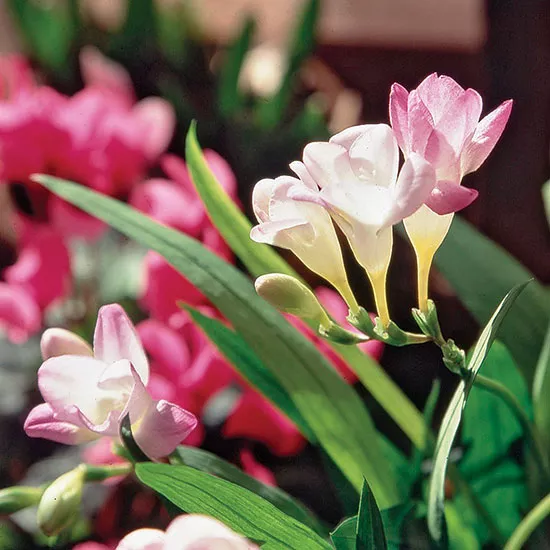
A native of South Africa, freesia pleases with upward-facing blossoms in bright colors and by adding a citrusy perfume to the air in late spring to early summer. Each freesia stem produces five to 10 tubular flowers, all of which grow on only one side of the stem. Double-flowered hybrids provide an even showier display. Worth noting: The stems turn at right angles just below the lowest flower, which results in blossoms that face the sky and attract pollinators. This characteristic makes freesia wonderful for arrangements.
Freesia Overview
| Genus Name | Freesia ssp. |
| Common Name | Freesia |
| Plant Type | Bulb, Perennial |
| Light | Part Sun, Sun |
| Height | 6 to 12 inches |
| Width | 2 to 6 inches |
| Flower Color | Blue, Orange, Pink, Red, White, Yellow |
| Foliage Color | Blue/Green |
| Season Features | Fall Bloom, Spring Bloom, Summer Bloom |
| Special Features | Attracts Birds, Fragrance, Good for Containers, Low Maintenance |
| Zones | 10, 9 |
| Propagation | Division |
| Problem Solvers | Deer Resistant, Drought Tolerant |
Where to Plant Freesia
Freesia is native to hot, dry regions of South Africa and thrives in similar environments in the garden. Hot, dry planting sites, such as south-facing foundation gardens and curbside and sidewalk gardens, are often great growing places for this plant—as long as it gets the cool nights it needs to flower well.
For the best visual effect, plant freesia in clusters of 6 to 10, either as groups of single colors or by mixing the colors to create a confetti effect.
How and When to Plant Freesia
In zones 9 and 10, plant freesia corms in the fall and you can count on freesia to unfurl its colorful racemes of flowers in spring. In cooler zones, plant corms after the last frost in spring and they will bloom in late summer or early fall.
Plant the corms with their pointed ends up, 1 to 2 inches deep and no more than 2 inches apart.
In zones 3 to 8, the tender corms won’t survive the winter, so you need to dig up them up after they have bloomed and the foliage has shriveled up but before the first frost. Store them in sand or coconut coir in a cool, dry place, at around 55 degrees F until you are ready to replant them in the spring.
Freesia Care Tips
Light
Freesia does best in full sun but a location with light morning shade will also work.
Soil and Water
Freesia grows best in well-drained, fertile soil that is rich in organic matter.
After planting, water them only sparingly; overwatering can lead to rotting. Once they start sprouting, water moderately in the absence of rain to keep the soil lightly moist. Once the summer heat sets in, freesia will go dormant and should not be watered any longer.
Temperature and Humidity
Freesia are hardy in zones 9 and 10. In zone 8 and below, their corms won’t survive the winter chill, so they need to be grown as an annual. Cool springtime temperatures between 55 and 60 degrees are prime time for freesia. While they tolerate humid conditions, they stop blooming and go dormant in temperatures over 70 degrees F.
Fertilizer
When the young plants are about 6” tall, begin fertilizing every 2 weeks with a liquid fertilizer according to manufacturer's directions.
Pruning
Freesia does not require pruning but after they bloom, it is crucial to let the narrow, bladelike leaves turn yellow, wilt, and shrivel completely before removing them. It is during that stage that the plant forms new bulblets.
Potting and Repotting Freesia
Freesia also grows well in containers placed in full sun or planted alongside annuals and perennials that do not require excessive watering.
In the early spring. fill a 5-inch-tall planting pot (freesia have long taproots) with a combination of well-draining lightweight potting mix and compost. Plant 6 to 8 corms with their pointed end up, 1 inch deep. This will give you a dense cluster of freesia in the late summer or early fall.
Alternatively, for spring-blooming freesia in containers, you can also plant them in pots in the fall and keep them in frost-free place where the temperature is consistently between 55 and 60 degrees F.
Pests and Problems
Insects that seek out freesia include aphids and thrips. You might also find snails and slugs feeding on them.
Potential common diseases include root and stem rot, which is often brought on in wet conditions, and also dry rot and fusarium wilt, a fungus.
How to Propagate Freesia
Freesia are best propagated from the corms, the bulbo-tuberous underground stems. The larger the corms, the more energy they contain and the larger the flowers will be. That’s why you should only select large, healthy corms when propagating your own freesia.
Gently remove the corm offsets from the parent plant, taking care to leave them intact. Plant the corms 2 inches apart or denser, following the instructions for planting freesia above.
Note, however, that when you propagate freesia from corms, they might not bloom the first season (unlike newly purchased freesia corms).
Freesia Companion Plants
A unique cutting flower, freesia is not commonly grown in the home garden and commands high prices at the florist. But growing your own freesia lets you enjoy all the beauty of florist shop bouquet right from your own backyard. Plant the elements of a charming garden bouquet by pairing freesia with dahlias, gladiolus, lady's mantle (Alchemilla mollis), larkspur, cosmos (Cosmos bipinnatus), amaranth, and pincushion flower (scabiosa). When creating a cutting garden, don't hesitate to plant in rows for easy care and harvesting all season long. Add structure to the planting bed by surrounding it with a low fence.