
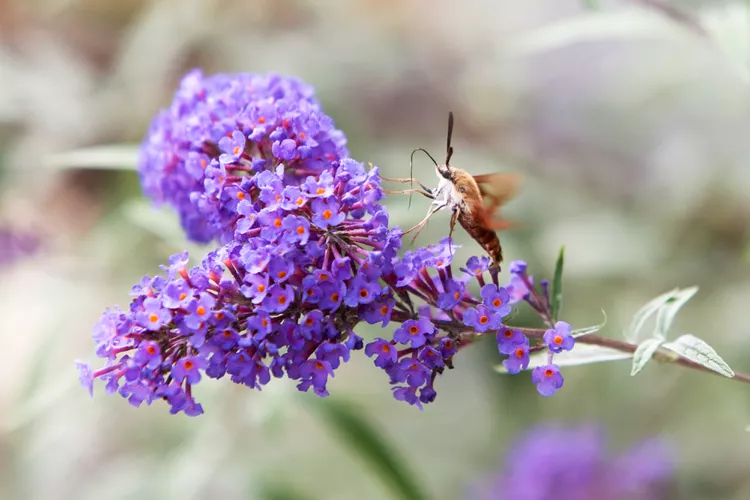
If you've ever seen a miniature version of a hummingbird zipping around from one flower to the next in your garden, you've likely encountered a hummingbird moth. At first glance, these giant insects are often mistaken for hummingbirds because of their similar movements and flight patterns. Unsurprisingly, these creatures are called hummingbird moths. But are they good bugs or bad bugs when it comes to your garden? Here's what you should know.
- Jim McHale is an entomologist, pest expert, and president of JPMcHale Pest Management.
- Dr. Tracy Ellis, Ph.D., is an entomologist at FarmSense, an agricultural insect monitoring company.
- Alex Kantor is the owner of Perfect Plants Nursery in Florida.
What Are Hummingbird Moths?
Hummingbird moths are flying insects that are about 1-2 inches long. They go by various names, depending on where you're located. "Hawk moth, hummingbird moth, and sphinx moth all refer to insects in the same family Sphingidae, named after the Egyptian sphinx,” explains Dr. Tracy Ellis, Ph.D., an entomologist at FarmSense, an agricultural insect monitoring company. "Latin nomenclature with an insect's scientific name is used to distinguish between very similar species of insects, simply because several common names refer to the same insect."
Types of Hummingbird Moths
"The United States has over 120 native species with similar morphology and biology to the tomato hornworm," says Dr. Ellis. According to Alex Kantor, owner of Perfect Plants Nursery in Florida, "Some common types in North America are the snowberry clearwing, white-lined sphinx, slender clearwing, and hummingbird clearwing."
The two most well-known moths are the tomato hornworm and the tobacco hornworm, but they have a bad reputation as caterpillars. They're unwelcome in the garden because they can devour tomato plants or any plant in the nightshade family quickly, often before you realize that you have a hungry caterpillar feasting on your plants. However, you may want them in your garden after they turn into moths because they help pollinate plants.
Other species of hummingbird moths lay their eggs on various host plants. "Upon hatching, these caterpillars feed on the host to derive nourishment. Host plants include honeysuckle, dogbane, hawthorn, cherry, plum, and viburnum," says entomologist Jim McHale. "Most species do not pose a huge threat to plant health."
Where and When to Find Hummingbird Moths
Hummingbird moths are attracted to fragrant flowers, which are more abundant in the warmer months. "Their activity varies depending on your area's bloom season," says Kantor. "During the spring and summer, whenever your flowers are blooming, is when they are most active."
The lifespan of a hummingbird moth ranges from weeks to months and depends on a variety of environmental factors. "These moths live from three weeks to seven months," says McHale. He explains that weather, shelter availability, and foraging ability all affect how long they live.
Tips for Attracting Hummingbird Moths
Hummingbird moths are important in the ecosystem. According to Dr. Ellis, "Both male and female flying hawk, hummingbird, or sphinx moths have a famously long 1-inch (25 mm) proboscis or insect tongue that rests curled up like a garden hose under their head, but when feeding, acts like a long straw that siphons nectar from flowers." This makes hummingbird moths beneficial pollinators to have in your garden.
Another benefit is that these moths are active both day and night. "Their ability to visit flowers throughout the day and night allows for the pollination of a wide range of plants, ensuring fruit production and continued biodiversity," says Kantor.
Use these tips to attract hummingbird moths to your garden.
1. Plant different-shaped flowers.
One way to attract hummingbird moths is to grow plants that flower at different times. Creating diversity in the garden benefits your plants, pollinators, and the ecosystem. "Plant a variety of flowers in your garden, including flowers with a variety of shapes, colors, and sizes with blooming times that differ by month and by time of day," says Dr. Ellis. "The hawk, hummingbird, and sphinx moths like flowers that are nectar-filled, tube-bottomed, or deep-throated flowers that bloom in the evening or early morning such as butterfly bush, citrus, morning glory, petunia, or honeysuckle. "
2. Choose flowers with a scent.
Another consideration to draw these moths to your yard is to grow flowers with a strong fragrance. "Hummingbird moths are attracted to sweet-smelling flowers, particularly those with trumpet-shaped blooms," says Kantor. "Some examples of flowers that they enjoy include bee balm, honeysuckle, moonflower, and jasmine." McHale adds to plant pale or white plants to draw them in.
3. Include larval host plants or trees.
Planting trees or plants where the moths lay their eggs for the next generation is one way to attract these moths. Each moth species has preferred larval host plants that they eat and where they lay their eggs.
According to Dr. Ellis, "While the tomato hornworm will devour tomatoes, peppers, tobacco, eggplants, and potatoes of the family Solanaceae, they also feed on related weeds such as jimsonweed, wild tobacco, and devil's claw or ornamental plants in the same family."
Dr. Ellis recommends determining what types of hawk, hummingbird, and sphinx moths are in your region and which larval host plants they eat in your area. "For example, to attract the giant sphinx moth (Cocytius antaeus) to my home in Southern California, I planted a cherimoya tree for the larvae," she says.
4. Avoid using harmful chemicals on your lawn.
If you have a lawn and apply lawn treatments, reconsider your products, as they can be toxic to many pollinators, including hummingbird moths. McHale suggests, "Insecticidal soaps, horticultural oils, and natural biocides work best when trying to preserve hummingbird moth populations." He recognizes that every situation is different but recommends a product "that decomposes quickly in sunlight or acts as a contact killer only [and] to avoid products that leave a residue."