
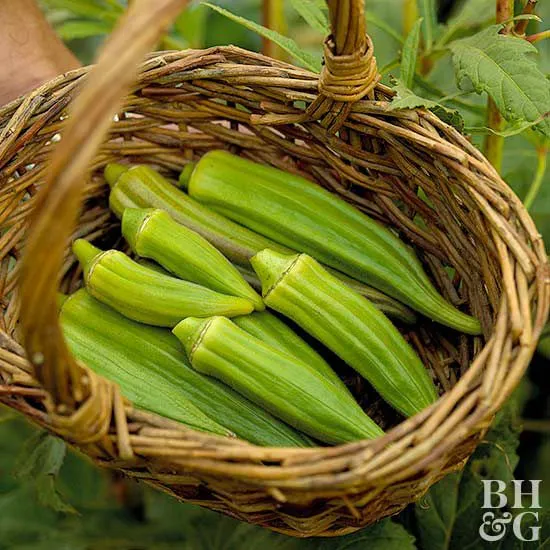
Traditionally a favorite in the South, okra is growing more popular in home gardens everywhere. It’s easy to see why. Okra is a nutritious vegetable that’s easy to grow and has ornamental value. While okra is often associated with gumbo because of its thick, viscous texture, there are a variety of other ways to enjoy it, too. Harvest fresh okra from the garden and enjoy it breaded and fried, baked, grilled, or pickled. And if you don’t eat it, you can still enjoy its textural hand-shaped foliage and attractive yellow flowers that appear all summer long. While most okra varieties have green pods, there are a few varieties that have edible and delicious seed pods in a range of other colors, including burgundy and red.
Okra Overview
| Genus Name | Abelmoschus esculentus |
| Common Name | Okra |
| Plant Type | Vegetable |
| Light | Sun |
| Height | 3 to 7 feet |
| Width | 3 to 4 feet |
| Foliage Color | Blue/Green |
| Special Features | Good for Containers |
| Zones | 10, 2, 3, 4, 5, 6, 7, 8, 9 |
| Propagation | Seed |
Where to Plant Okra
Plant okra in a location where it gets full sun and the soil is well-drained and slightly acidic. Choose a location where you haven’t grown okra in at least the two previous seasons.
Okra is a relatively large vegetable; it can grow as much as 7 feet tall depending on the variety and growing conditions. It is ideal for growing in the back of the garden mixed in with other summer flowers and veggies, or featured by itself or combined with other veggies in container gardens. Be sure to plant okra where you can enjoy the beauty of its golden-yellow blossoms.
Make the most of your garden space by succession planting. Plant lettuce early in spring, then once summer heat arrives and the lettuce fades, plant okra in its place.
Okra pairs beautifully with eggplant, another summer vegetable whose pretty purple flowers and fruit contrast with okra's yellow blooms. Or, play off okra's tropical look with the flamboyant edible flowers of nasturtium.
How and When to Plant Okra
Okra is a warm-season annual vegetable that loves summer heat. Whether you start it from seed or buy transplants, wait to plant it outdoors until night temperatures reliably stay consistently above 55 degrees F.
Ideally, okra is direct seeded in the garden but if your growing season is short, you can also start it indoors three to four weeks before your last average frost date. Use biodegradable pots because okra has a deep tap root that does not like to be disturbed.
Before planting, soak the seeds for 12 to 18 hours in room-temperature water to soften the hard seed coat. Plant the seeds 1 inch deep and place a seed every 4 to 8 inches. Keep the soil evenly moist. Okra seeds take 12 to 14 days to germinate. Once the seedlings are 4 to 6 inches tall, thin them out to 18 to 24 inches apart, which is also the spacing if you are using transplants from a nursery.
Okra Care Tips
Once the plant is established, okra is a low-maintenance vegetable.
Light
Plant okra in a spot that gets full sun, at least 6 to 8 hours of direct sunlight.
Soil and Water
Okra does best in rich, well-drained soil with a pH between 6.0 and 6.8. If your garden has a lot of sand or clay, amending liberally with compost will help keep your okra plants looking their best and staying productive through the season.
After planting, spread a 2- to 3-inch-deep layer of mulch (such as pine needles, shredded bark, or straw) over the soil around the plants to help keep the ground moist and prevent weeds from sprouting.
Okra has a tap root, which helps it survive drought conditions well. However, regularly watering your okra deeply will help ensure steady harvests all summer and into the fall.
Temperature and Humidity
Okra is a heat-loving crop that thrives in temperatures between 80 and 90 degrees F. The plant tolerates dry and humid conditions without problems but it is highly sensitive to cold and will do poorly in a cool climate.
Fertilizer
If your garden soil is rich in organic matter, there is generally no need to fertilize okra. If you have nutrient-poor soil, fertilize regularly with a water-soluble fertilizer or mix a time-release fertilizer into the soil at planting time, according to product label instructions.
Pruning
It is not necessary to prune okra, unless your climate is mild and you want to encourage a second harvest in the early fall. In that case, when fruit production considerably slows down in the summer, cut the plants down to 6 to 12 inches and add a granular fertilizer that is high in nitrogen and potassium, such 9-0-9. Water the plants deeply and keep watering in the absence of rain.
Pollination
Okra is self-pollinating; it does not require insects for pollination and it only takes one plant to produce fruit.
Potting and Repotting
Okra can be grown in containers but smaller or dwarf varieties such as ‘Little Lucy’ or ‘Baby Bubba’ work best. Because okra has a deep tap root, choose a container that is at least 12 to 15 inches deep. You can plant a single okra in a 5-gallon container or grow three plants together in a 15-gallon container. Fill it with well-draining organic potting mix and make sure the container has large drainage holes. Like all potted plants, okra in a container needs more frequent watering than plants in the garden; in hot summer weather, you might need to water daily.
Pests and Problems
While okra is a fairly rugged crop, its foliage is susceptible to pests that feed on leaves, such as aphids, thrips, whiteflies, and mites, and caterpillar larvae of fall armyworm, cabbage looper, and corn earworm. It can also get a range of fungal diseases including powdery mildew and fusarium wilt.
How to Propagate Okra
Okra is propagated from seed, which you can collect from your plants and save for next year if it’s an open-pollinated heirloom variety. For propagating okra from seed, follow the instructions for how to plant it above.
Harvesting
Pick the fruit—the seed pods—when they are young, about 2 to 4 inches long. If you wait too long, they will be tough and stringy. Once they have reached the mature stage, okra plants continuously produce flowers and fruit shortly afterward, so harvest the pods frequently. Even spineless okra varieties cause skin irritations so wear gloves and use pruners to harvest the seed pods.
Types of Okra
'Annie Oakley II' Okra
'Annie Oakley II' is a good variety for northern climates because it matures faster than other okra varieties. Plants grow 3 to 4 feet tall and produce spineless green pods. 50 days
'Burgundy' Okra
This variety offers deep red stems and pods. The pods turn deep purple when cooked. The plant grows 7 feet tall. 60 days
'Clemson Spineless' Okra
'Clemson Spineless' is a popular green variety that produces pods up to 9 inches long before they become tough. Spineless plants grow to 5 feet tall. 56 days
'Little Lucy' Okra
This variety has the same coloration as 'Burgundy' but grows only 2 feet tall and produces 4-inch-long pods. 55 days
Frequently Asked Questions
- What month can I plant okra?
The planting time depends on your last frost in the spring and your first frost in the fall. In the spring, the general rule of thumb is that soil temperature needs to be at least 60 degrees for the seeds to germinate. For a fall crop, count back three months before the first fall frost date. If your first fall frost is around October 31, you should get the seeds for the fall crop in the ground by August 1.
- What should not be planted near okra?
Don’t plant okra next to eggplant, squash, tomato, or sweet potato, because just like okra, they are highly susceptible to root knot nematodes and could transmit them. The tiny worms live in the soil and parasitize okra roots.
Updated by Nadia Hassani