
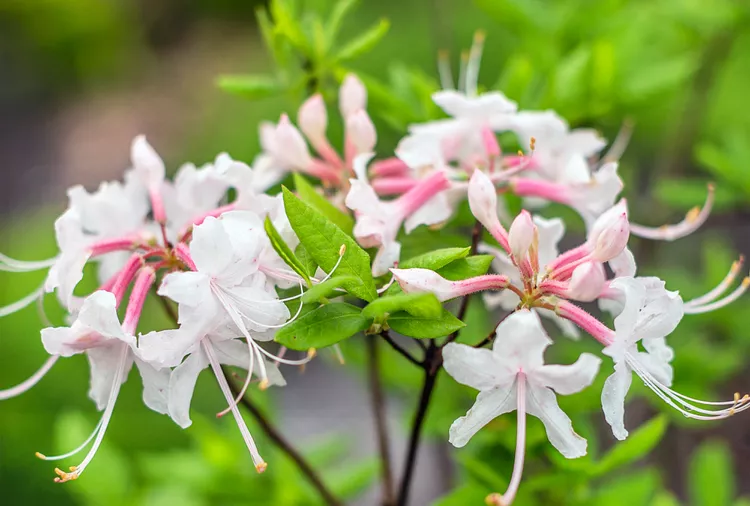
Pruning azaleas is usually not necessary, but there are times when the thoughtful use of pruners enhances the appearance of these beautiful flowering shrubs, promotes healthy growth, and results in more flowers. There are several pruning strategies to keep your azaleas in top form. These include removing damaged and diseased branches, maintaining the desired shape and size, and promoting good air circulation with selective cuts, and—when necessary—rejuvenating an old, overgrown plant.
For these azalea pruning objectives, timing is critical; prune at the wrong time, and you may eliminate your flower show the following year. Use this guide to learn when and how to prune azaleas properly.
Pruning Different Types of Azaleas
Deciduous and evergreen azaleas are all species in the Rhododendron genus, but they differ somewhat in how they are pruned.
Deciduous Azaleas
Deciduous azaleas, many of which are native to North America, have open, informal habits that are well suited to woodland gardens and informal landscapes. They can be large—a few species grow 15 to 20 feet tall and can assume the role of a small tree. Most flower in spring, although a few bloom in summer. Deciduous azaleas rarely need pruning beyond removing broken or diseased branches.
Evergreen Azaleas
Evergreen azaleas mostly hail from Asia and are more dense, compact, and lower-growing. These shrubs are often wider than they are tall. They range from less than 2 feet to more than 10 feet in height and fulfill a variety of landscape purposes. With such a range of sizes, careful selection of the variety for your garden makes a big difference in the amount of maintenance pruning that is necessary. Most evergreen azaleas flower in early to mid-spring, though some rebloom in summer and fall.
In addition to removing diseased or broken branches, gardeners use maintenance pruning to enhance the form of evergreen azaleas, maintain their size, and increase flower production. If your azaleas have outgrown their space or need serious renewal, a more drastic procedure—rejuvenation pruning—is called for.
Use sharp bypass hand pruners for small pruning cuts (up to ½ inch in diameter) and long-handled loppers for larger cuts. Be sure the blades are well-sharpened so the cuts are clean.
When to Prune Azaleas
The best time to prune azaleas is immediately after they bloom—within three weeks after their flowers fade. Next year’s flower buds form the summer before they bloom, so if you wait until mid-July or later to prune, you remove flower buds and reduce the following year’s flowering display.
This timing applies to rebloomers—such as Encore Azaleas—as well. While they usually require minimal pruning, light pruning after their spring bloom encourages new growth. Since they flower both on new and old growth, light pruning can increase the overall number of blooms.
Do not prune any azaleas in late summer or fall. It stimulates tender new growth that is easily damaged by winter weather.
There are a few exceptions to the timing of azalea pruning: any time during the year that you notice a broken or diseased branch, remove it, making the cut just above another branch, leaf, or leaf bud. This helps the plant heal and prevents disease spread. Dispose of any diseased portion of the plant in the trash, not your compost pile.
When removing a diseased branch, disinfect your pruners after each cut by dipping them in a 20% solution of bleach in water.
Rejuvenation pruning should be done in late winter or very early spring before new growth begins. Although rejuvenation pruning reduces or eliminates flowering for that year, it results in a healthier, more vigorous plant sized to suit your space.
Maintenance Pruning
Although azaleas look their best when allowed to maintain an informal mounded shape, sometimes a few judicious pruning cuts are called for to keep them looking tidy or prevent them from growing into a walkway. Identify any stray shoots or stems that are encroaching on space where you don’t want them or that detract from the overall form of the plant.
Reach into the plant and remove the stem, making the cut just above a leaf or another branch so that the cut is hidden by surrounding foliage. If you are making several cuts, make them slightly different lengths to maintain a natural mounding shape. Use hand pruners for smaller cuts and loppers for larger branches. Loppers are usually needed if you plan to reduce the shrub‘s size significantly. You can cut large branches back to about 12 inches if needed.
An additional benefit of maintenance pruning is that it allows air and light to penetrate the center of the plant, which helps prevent disease and encourages more flower bud development.
After pruning, apply a slow-release fertilizer for acid-loving plants around the base of the shrub and water your plant well.
Rejuvenation Pruning
You may have inherited an overgrown azalea when you bought your house, or an azalea you planted may have completely outgrown its space and is overtaking a garden bed or covering a window. You can give an old or overgrown azalea a new lease on life, but it takes drastic measures. There are two approaches—get it done all at once or space it out over a few years. Late winter to early spring—before new growth begins—is the best time for either approach.
The first strategy involves cutting all branches (using loppers or a pruning saw) back to about 6 to 12 inches from the ground. Believe it or not, those bare stumps will sprout an abundance of new shoots in a few short months—so many that you may want to thin them out a bit. The downside of this approach is that you lose a year of flowering. However, you will have a shorter, more vigorous and dense shrub loaded with blooms in the following years.
The second approach is slightly more measured, although it follows the same principle. In late winter or early spring, cut one-third of the branches of the azalea back to 6 to 12 inches. The following year, cut another third of the old growth down to the same height and repeat the next year. So, you are spreading out the process over three seasons. You will still have some flowers every year, but it takes three years to complete the desired renewal process.
Size Matters
With their wide range of flower colors, azaleas are among the most glorious spring-blooming shrubs, and they come in so many sizes that it’s easy to work them into most garden designs. If you select the right size azalea and the conditions of the site are to their liking, only minimal pruning is needed.
Avoid a lot of work by selecting an azalea whose mature height and width are appropriate for your planting space. Plan carefully so the azalea won’t extend into a walkway, crowd out other plants, or cover a window. Remember that azaleas look best when you maintain their natural form; make your pruning cuts at different lengths into the shrub‘s interior to avoid a crew cut appearance and camouflage the cuts with foliage.